Bon’s grief after bereavement
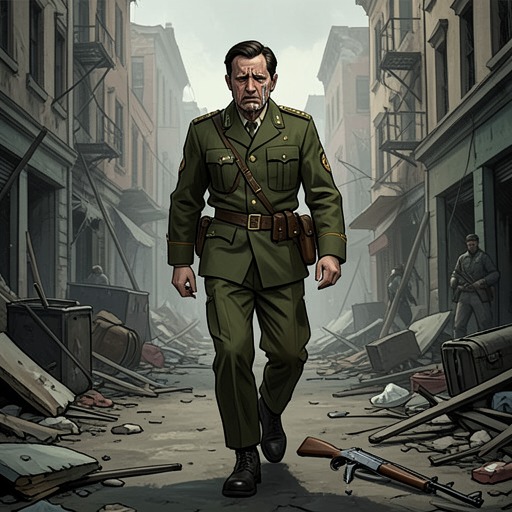
The SympathizerBon’s grief after bereavement shapes his passage from the evacuation of Saigon into refugee life and exile. When his wife, Linh, and their son, Duc, are killed as they try to leave, Bon is left with a loss he cannot resolve: the bullet’s source is unknown, and the possibility that it came from either friend or foe continues to haunt him. His grief is shown not as a single moment of mourning but as an ongoing condition, witnessed by the narrator in the immediate aftermath, at the burial, and in the struggle to keep Bon alive and functioning afterward.
The deaths during evacuation
As the General reaches the aircraft ramp, the narrator notices that Linh and Duc are no longer behind him. They have been hit on the runway. Bon is kneeling beside Linh, holding her, while the narrator sees that Duc has also been struck. With the plane preparing to leave and gunfire continuing nearby, the narrator runs back to them. Bon will not respond to the demand to board. The narrator pulls him away from Linh and carries her to the aircraft; Duc is left on the tarmac. In this sequence, the urgency of the evacuation and Bon’s inability to leave his family collide. The narrator’s actions get Bon onto the plane, but cannot spare him the experience of being separated from his dying family.
After landing on Guam, the narrator lowers Duc onto a stretcher. He finds it difficult to lay the child down, even as the medics prepare to take the bodies away. They remove Linh from Bon’s arms and cover both her and Duc before placing them in an ambulance. The narrator weeps, and Bon weeps more intensely. Their different expressions of sorrow are recorded without making either grief seem lesser: the narrator understands himself as unable to match the tears Bon has held back over a lifetime. The loss follows them as they are transported to Camp Asan.
Burial and unresolved blame
The following day, Linh and Duc are buried. Their bodies had remained overnight in a naval morgue, and the official cause of death is recorded as a single bullet of unknown type. That official uncertainty becomes an enduring torment for Bon. He cannot determine whether the shot came from a friend or an enemy; either possibility keeps the event open in his mind rather than allowing it to settle into a comprehensible account of what happened.
Bon wears a white mourning scarf made by tearing a bedsheet. Duc’s small coffin is lowered on top of Linh’s, placing mother and son together in one grave. Bon throws himself into it and cries out in anguish. The narrator climbs down to calm him and helps him out before they cover the coffins with earth. The General, Madame, and the exhausted priest watch silently. The burial thus gives Linh and Duc a shared resting place, but offers Bon no explanation for their deaths and no relief from the question of why they were the ones lost. The narrator calls them innocents, especially Duc, his godson; the burial also makes plain that the narrator’s sorrow is bound to Bon’s, not separate from it.
Grief in the refugee camp
In a letter addressed to an aunt the narrator pretends is his, he reports that Bon is not in a good state. At night Bon tosses and turns in the bunk above the narrator, while memories of Man, their blood brother, and of Linh and Duc return to him. The narrator describes the dead as tied to the guilt he and Bon carry, since they believe they abandoned Man and associate themselves with the bloodshed that took Linh and Duc. The account connects bereavement to a wider burden of wartime responsibility without suggesting that Bon can distinguish or resolve those feelings.
The narrator also describes the practical care required to sustain Bon. Bon would have starved if the narrator had not pulled him from his bunk and taken him to the mess hall, where they ate tasteless food at communal tables. Thousands of refugees shared showers without stalls and crowded barracks with strangers. The General experienced these conditions as well, and the narrator spent much time with him and Madame. These details place Bon’s private loss inside the collective dislocation of the refugee camp: mourning continues amid shared, basic hardships, rather than in a protected space set aside for grief.
Bon is catatonic on his bunk and later remembers nothing of the evacuation footage shown on television that afternoon and the next day. Around them, refugees in the temporary city wail. The contrast between a televised account of the evacuation and Bon’s inability to remember watching it underscores how little ordinary public representation can contain of his immediate loss. His silence and blankness are not presented as recovery; they are part of the condition in which the narrator has to care for him.
Survival and the limits of recovery
In the United States, Bon works part-time at night as a janitor at a church. The church pays him in cash, allowing him to receive welfare as well; the narrator describes his shame as marginal and his sense of entitlement as considerable. Bon’s reasoning is practical: after serving in a war determined by the United States for little compensation, he sees welfare as a better reward than a medal. His former military abilities—parachuting, carrying heavy equipment over long distances, shooting accurately, and enduring punishment—do not give him a place in civilian life. The account presents this mismatch as part of his exile, not as a cure for bereavement: survival requires accepting work and assistance in a society with no use for the skills that defined his service.
Later, the narrator says that he is again trapped by circumstances and sees another man trapped by them. The one compensation for his sadness is that Bon looks happy for the first time in a year. This brief change matters precisely because the narrative measures it against a year of visible suffering. It provides evidence that Bon can appear happy again, but it does not establish that his grief has ended or that the loss has been repaired. Across the account, his bereavement remains inseparable from the uncertain death of Linh and Duc, the refugee experience, and the narrator’s ongoing role as witness and caregiver.